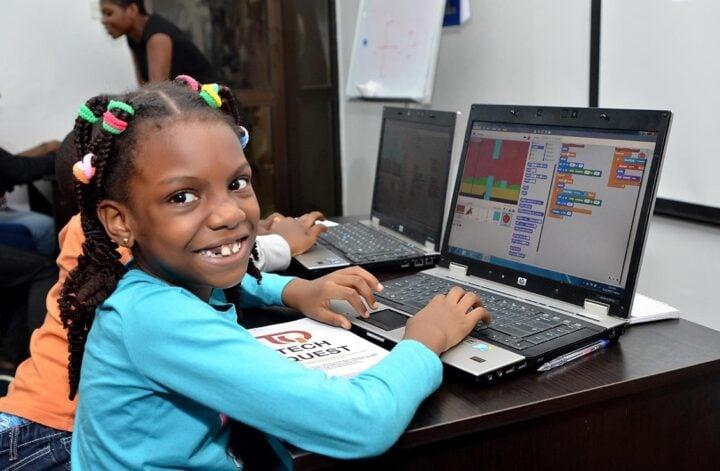
For more than two decades, Sweden stood at the forefront of digital education, embedding screens into classrooms with the promise of modern learning and improved outcomes.
- +Screens in classrooms: Sweden’s 21-yr lesson for Nigeria
Laptops, tablets, and interactive tools became central to teaching, shaping how students read, write, and engage with knowledge.
Laptops, tablets, and interactive tools became central to teaching, shaping how students read, write, and engage with knowledge. But after 21 years of experimentation, the results are far more complex than the early optimism suggested.
According to Tunji Alausa, minister of education, the Nigerian education system is being repositioned to meet the demands of the digital economy and build a globally competitive, knowledge-based society.
“The shift from chalkboards to smartboards marks a transition from traditional, one-directional learning methods, characterised by repetitive teaching, to dynamic, interactive, and technology-enabled active learning, where students learn by engaging, exploring, and creating,” he said.
As Nigeria accelerates its own push toward digital classrooms, Sweden’s experience offers a timely and cautionary lens, one that raises critical questions about balance, effectiveness, and what truly drives learning in the modern age.
In the late 2000s and early 2010s, laptops became mainstream in Swedish classrooms. By 2015, around 80 percent of pupils at municipal state-funded high schools had individual access to a digital device, according to official data.
The compulsory use of tablets in pre-schools was included in the curriculum in 2019, as part of the previous Social Democrat-led government’s mission to prepare even the youngest children for an increasingly digital work and private life.
However, the current right-wing coalition, which came to power in 2022, is moving teaching in a different direction.
Joar Forsell, an education spokesperson for the Liberal party whose leader is Sweden’s education minister, said, “We’re trying, actually, to get rid of screens as much as possible.
“With higher ages in school, you might use them a little bit more, but with lower ages, or in school, I don’t think we should use screens at all.”
The Swedish government is championing a renewed focus on physical books, paper and pens in classrooms, designed to reverse falling literacy levels.
Schools have already been allocated more than $200 million (£157 million) in grants to invest in textbooks and teacher guides, and a new curriculum designed to enforce textbook-based learning is due in 2028.
The government argues, “Reading real books and writing on real paper, and counting with real numbers on real paper, is much better if you want kids to get the knowledge they need.”
No doubt, some stakeholders argue that the incorporation of technology in education has become a need rather than a choice in the fast- changing scene of the global labour market.
For Nigeria, they say, this goes beyond mere speed to include changing the educational system to equip a generation capable of flourishing wherever.
Be that as it may, a fact remains that a lot of devices and technology in classrooms without clear pedagogical intent, without clear goalposts, amounts to mutilating a child’s academic future.
While technology has transformed classroom teaching and learning, it also comes with some negative impacts, such as excessive dependence on technology, digital divide, distraction, and health challenges, among others.
Evidence indicates that indiscriminate digital expansion has weakened learning environments rather than strengthened them.
Sola Kayode, a parent, argues that the introduction of smart schools in some states has created a gulf among learners.
“Unequal access to digital tools intensifies scholastic inequalities, with some students not having the necessary facilities and reliable internet access for learning,” she said.
Isaiah Ogundele, a parent, does not see anything wrong with adopting digital classrooms, but urged policymakers to learn from the mistakes of other countries in adopting tech-classrooms.
“Nigeria should learn from the mistakes of others to check the excesses that may originate from it.
“There is nothing bad in digital classrooms and learning, which is different from the analogue that we all passed through,” he said.
In the fore of this, one question that comes to mind is how digital education has fared in Nigeria since its introduction.
The digital policies are mainly statements of intention; the implementation of such an ambitious intention has not been achieved.
Many schools are faced with physical and pedagogical challenges, such as a lack of electricity, poor technology infrastructure, low bandwidth, a lack of internet connectivity, insufficient and inappropriate software, and insufficient human capital to impart these digital technologies, which means those with skills in digital technologies are insufficient in numbers.
There is also the question of funding. The government has not sufficiently funded education, let alone funding digital technologies in the educational system.
Sweden’s 21-year journey with screens in classrooms shows that technology alone is not a silver bullet for better education. While digital tools can expand access and enhance learning, their impact depends heavily on how, when, and why they are used.
For Nigeria, the lesson is clear: adopting screens should be guided by evidence, balanced with strong teaching practices, and supported by investments in teacher training and foundational skills like reading.