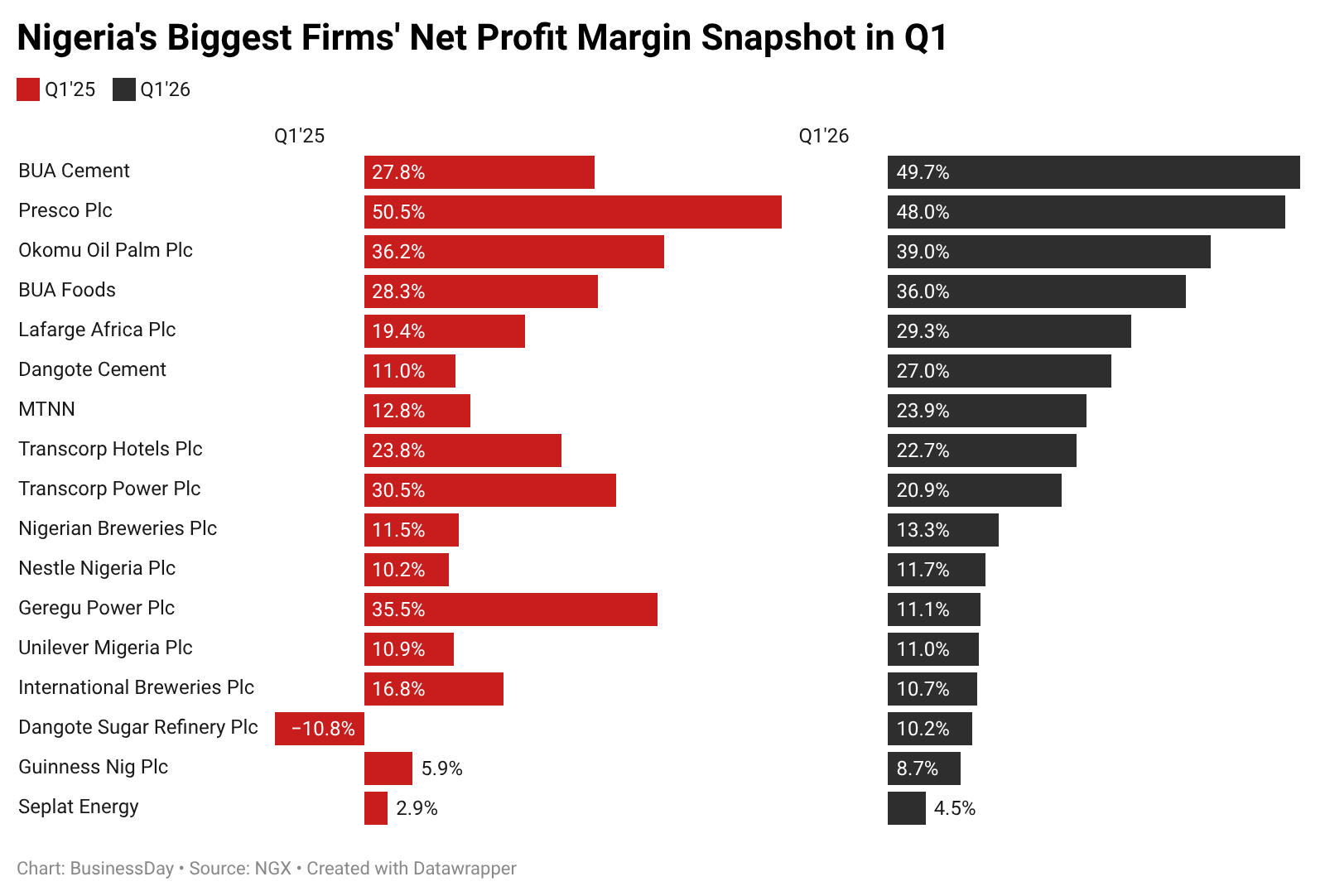
Across Nigeria’s biggest firms, BUA Cement and Presco Plc have emerged as the most profitable, leading the pack in net profit margin performance for the first quarter of 2026, new data has shown.
- +BUA Cement, Presco top Nigeria’s Q1 profitability rankings
- +Sector divergence reflects uneven economic recovery
- +Macro pressures reshaping corporate profitability
Profit margin, a key indicator of how efficiently companies convert revenue into profit, has become an important benchmark for investors amid rising inflation, high interest rates, and foreign exchange volatility.
Profit margin, a key indicator of how efficiently companies convert revenue into profit, has become an important benchmark for investors amid rising inflation, high interest rates, and foreign exchange volatility.
According to BusinessDay’s analysis of Nigeria’s biggest non-financial firms, seventeen firms surveyed collectively reported a 75 percent surge in their after-tax profit to N1.38 trillion in the first quarter of 2026 from N787 billion in the same period of 2025.
However, while MTN and Dangote Cement dominate in profit size, the margin ranking presents a different set of winners.
At the top of the profitability ranking is BUA Cement Plc, which posted a net profit margin of 49.7 percent, nearly doubling its position from a year earlier. The company’s performance reflects a combination of aggressive price adjustments and improved plant efficiency.
Yusuf Binji, the company’s managing director, disclosed in the Q1 earnings release that “The firm’s performance was driven by cost efficiency, reflecting the outcome of management’s earlier strategic alignment, and supported by strong interest income growth and foreign exchange gains.”
Within the same industry, Dangote Cement and Lafarge Africa also recorded strong margin growth, at 27.0 percent and 29.3 percent, respectively. Both companies leveraged pricing power and higher capacity utilisation to offset cost pressures, reinforcing the cement sector’s position as one of the most profitable segments of the economy.
Outside cement, agro-processing firms delivered some of the strongest margins. Presco Plc posted a margin of 48.0 percent, while Okomu Oil Palm Plc recorded 39.0 percent.
Sector divergence reflects uneven economic recovery
The data highlights a widening gap between sectors; telecom firms are driving margin expansion, while consumer-facing sectors remain under pressure despite margin growth.
MTN Nigeria recorded a margin of 23.9 percent, reflecting recovery driven by data revenue growth and tariff adjustments. The telecom sector continues to benefit from strong demand for digital services, even as household incomes remain constrained.
In contrast, consumer goods firms such as BUA Foods Plc reported a margin of 36.0 percent, supported by price increases across staple products and steady demand. The company has been able to pass rising costs to consumers more effectively than its peers, reflecting the essential nature of its product lines.
Unilever Nigeria Plc (14 percent), Nigerian Breweries Plc (13.3 percent), Nestlé Nigeria Plc (11.7 percent), Dangote Sugar Refinery (10.2 percent), and Guinness Nigeria (8.7 percent) posted moderate margin growth.
Meanwhile, International Breweries Plc saw profit decline from N29 billion to N19 billion, alongside margin compression to 10.7 percent from 16.8 percent, as profitability is impacted by rising cost pressures and weak consumer purchasing power.
Macro pressures reshaping corporate profitability
The margin expansion across leading firms comes against a backdrop of elevated macroeconomic pressure. Inflation has remained high, driven by energy costs and supply chain disruptions linked partly to geopolitical tensions in the Middle East.
According to the Nigerian Bureau of Statistics (NBS), Nigeria’s inflation rate rose to 15.38 percent in March from 15.06 percent in February, reinforcing concerns that underlying price pressures remain persistent and complicating the outlook for monetary policy ahead of the Central Bank of Nigeria’s (CBN) May meeting.
Many companies acknowledged Nigeria’s stable naira for its ability to moderate foreign exchange loss, which had been the biggest problem of companies’ ability to report profit growth in prior years.
Data published by the Central Bank of Nigeria (CBN) showed that at the close of trading on April 30, the naira appreciated by N3.76 against the dollar at the NFEM, ending the month at N1,374.94 compared to N1,378.70 at the beginning of April, representing a gain of 0.27 percent.
In the parallel market, the local currency also strengthened, appreciating by N10 to close at N1,400 per dollar, a 0.7 percent gain from its opening level of N1,410 recorded on Wednesday at the NFEM.
Speaking during the International Monetary Fund (IMF)/World Bank Spring Meetings in the US, Olayemi Cardoso, Central Bank of Nigeria (CBN) Governor, said Nigeria’s experience indicates that spillover effects from the Middle East crisis, which led to a marginal rise in the inflation rate in March, have been relatively contained.
He said the ability of the economy to contain the economic headwinds from the crisis reflects positive reform outcomes, including exchange rate stability, stronger reserve buffers, and an enhanced monetary policy framework.
Cardoso said, “We are not relenting on continuing to build resilience and also to stay the course with respect to something we have constantly been talking about, and that is bringing down inflation to single digits. Despite all that is going on, we will stay that course.”
Muyiwa Oni, head of equity research, West Africa at Stanbic IBTC Bank, disclosed in the March PMI release by the bank that “while higher fuel costs and power supply issues contributed to a slowdown in the growth of Nigeria’s private sector activity, underlying demand remains strong.”
The PMI numbers in Q1:26 are consistent with an estimated 3.99 percent year-on-year GDP growth for the quarter, after also accounting for the crude oil sector’s performance. We now see the Nigerian economy growing by 4.22 percent in 2026, from 3.87 percent in 2025.
“Nonetheless, the ongoing tensions in the Middle East pose a downside risk to the growth outlook as higher inflation emanating from sustained increases in fuel prices may lead to higher-for-longer interest rates. This may influence a slowdown in demand conditions should the tensions continue to escalate,” he said.