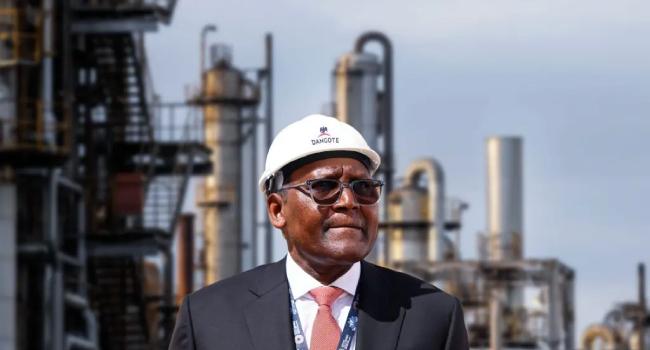
Aliko Dangote said he is targeting a $50 billion valuation for his refinery business ahead of a planned stock market listing in Nigeria later this year.
- +Dangote Targets $50bn IPO Valuation For Refinery
A report by Bloomberg, quoting sources, noted that the company wants to sell up to a 10 per cent stake, potentially raising around $5 billion in one of Nigeria’s biggest capital market deals.
A report by Bloomberg, quoting sources, noted that the company wants to sell up to a 10 per cent stake, potentially raising around $5 billion in one of Nigeria’s biggest capital market deals.
The 650,000-barrels-per-day refinery has transformed Nigeria’s fuel supply chain by reducing dependence on imported petroleum products.
A senior executive at the Dangote Group confirmed to Bloomberg that the projected valuation reflects the company’s internal expectations but declined to comment further on the timing or structure of the transaction.
The planned listing comes as rising global crude oil prices and stronger domestic fuel consumption improve the refinery’s commercial outlook. Located in the Lekki Free Zone in Lagos, the facility has a refining capacity of 650,000 barrels per day, making it Africa’s largest single-train refinery.
The Dangote Group had appointed a consortium of three financial advisers to manage the offering. Stanbic IBTC Capital, operating under the Standard Bank umbrella, will handle the international book-building process and lead engagement with foreign portfolio investors.
Vetiva Capital Management, which has advised on previous Dangote listings, will manage retail investor distribution within Nigeria, while FirstCap will focus on placements with Nigerian institutional investors, particularly pension funds, according to the report.
Since beginning large-scale production of petrol, diesel, and aviation fuel, the refinery has reshaped Nigeria’s fuel supply chain, reducing reliance on imported petroleum products and increasing local refining capacity in Africa’s biggest oil producer.
Dangote recently indicated that Nigerian investors would soon have an opportunity to buy shares directly in the refinery business, signalling a broader push to attract domestic participation in the energy sector.
The IPO is anchored by an unprecedented dividend structure that allows investors to purchase shares in Nigerian naira but receive returns in US dollars, backed by an estimated $6.4 billion in annual petrochemical export revenues.
With the prospectus already submitted for regulatory review and a subscription window expected to open by August 2026, the Dangote Refinery IPO is poised to fundamentally alter the scale and ambition of African equity markets.
It will also be the first time that the Refinery will become available for public ownership. The refinery, located in the Lekki Free Trade Zone near Lagos, was commissioned in May 2023 after nearly a decade of construction and an investment of approximately $20 billion.
By February 2026, the facility had reached its full processing capacity of 650,000 barrels of crude oil per day, making it the world’s largest single-train refinery and Africa’s biggest refining complex.
Earlier valuations published in late 2025 placed the refinery’s worth at between $20 billion and $25 billion. That figure has since nearly doubled to $40–$50 billion, reflecting stronger-than-expected operational performance and rising global demand for the refinery’s output.
Group revenues across Dangote’s businesses have grown from $3.3 billion to $18 billion over the past five years, while EBITDA rose from $1.8 billion to $2.8 billion during the same period.
The refinery processes crude oil into diesel, aviation fuel, and petrol, with refined products currently exported to Ghana, Cameroon, Togo, and Tanzania, as well as international markets, including Europe. It currently supplies over 90% of Nigeria’s petrol demand and has exported 456,000 tonnes of refined fuel to five African countries.
Beyond fuels, the refinery produces petrochemical outputs including polypropylene, which is widely used in plastics manufacturing, industrial packaging, and component fabrication. The petrochemicals division represents a major standalone revenue stream and is specifically what underpins the refinery’s dollar dividend commitment.
Jet fuel exports alone surged by 770 per cent between 2024 and 2026, with Europe receiving roughly 70,000 barrels per day to offset supply disruptions linked to tensions in the Middle East.
The refinery is also supported by a pipeline network stretching approximately 1,100 kilometres, one of the largest of its kind globally, connecting crude supply lines to processing and distribution infrastructure.